

This section analyzes the Profit and Loss (PnL) profile of a delta-neutral liquidity provider (LP) position, referred to as a Borrowed LP. In this structure, the initial spot price exposure (delta) is offset at inception, isolating the position’s sensitivity to price movement rather than direction. A “Borrowed LP” is distinct from a standard (“Funded”) LP position. While a standard LP is long the underlying asset, a Borrowed LP is constructed to be delta-neutral at inception. This can be achieved through two equivalent methods:
  1. Borrow & Deposit: You deposit stablecoins (e.g., USDC) into a lending protocol, borrow the volatile asset (e.g., ETH), and pair them to provide liquidity.
  2. Deposit & Hedge: You provide liquidity using your own capital (ETH + USDC) and simultaneously open a short position of equal value on a perpetual exchange.
In both constructions, the position is locally delta-neutral at the entry price. Small price changes around the entry price do not generate first-order directional PnL.

Concave PnL Profile

The key structural feature is that the LP position is short gamma. While the hedge (short perp or debt) introduces a linear payoff, the AMM inventory rebalancing produces a concave payoff profile. Subtracting a linear hedge from a concave curve preserves the concavity, resulting in negative convexity overall. Ignoring fee income, the position’s mark-to-market value is maximized at the entry price PentryP_{entry}. As price moves away from this level in either direction, the position loses value.
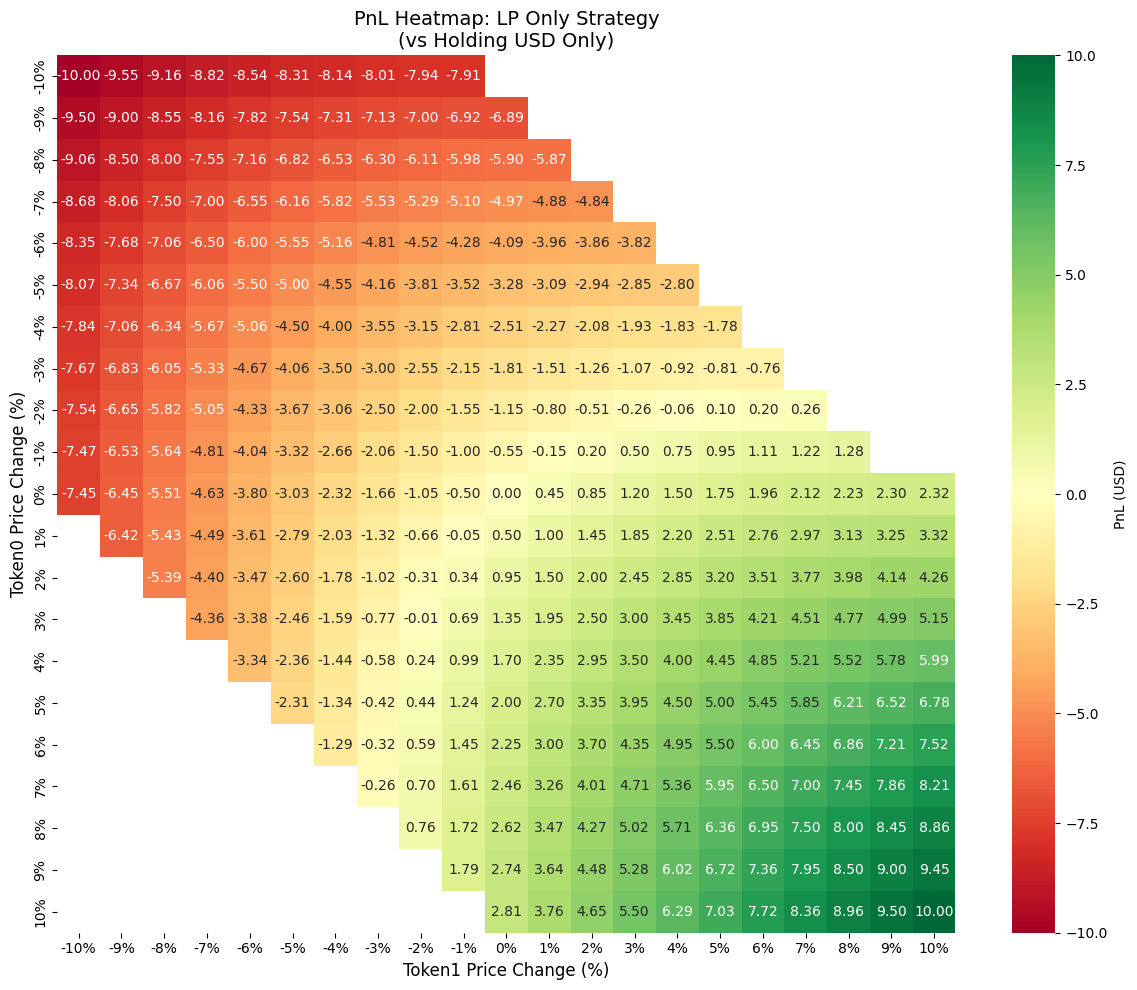
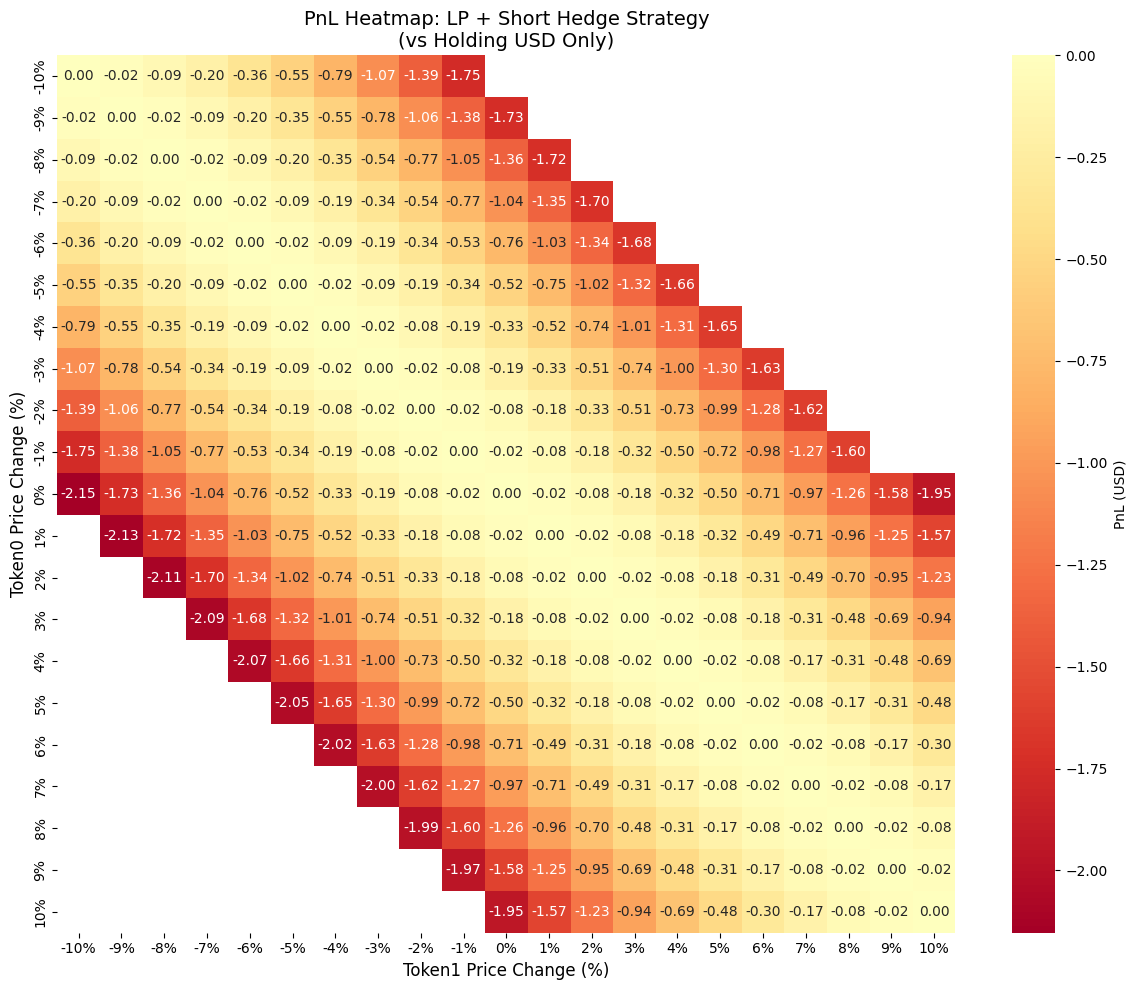
PnL Profile of Funded LP PositionPnL Profile of Borrowed LP Position
The left figure shows the PnL of a funded LP position at different prices. The right figure shows the PnL of a borrowed LP position at different prices. This concavity arises from the mismatch between the hedging instrument and the LP position:
  • The Short Hedge (or debt) is linear. If price moves +10%, the short loses exactly 10%.
  • The LP Position is non-linear (concave). As price rises, the LP sells the appreciating asset (ETH) for the stable asset (USDC). It captures less upside than a simple hold.
When you subtract the linear hedge from the LP curve, the result is a curve that bends downwards on both sides. In option-theoretic terms, a delta-neutral LP position is economically similar to being short a straddle: it benefits from low realized volatility and loses value as price moves away from the initial level. The LP earns trading fees that function as option premium, while impermanent loss represents the volatility cost of the short option exposure. You profit from fees when the price is stable, but suffer losses (“Impermanent Loss”) when the price moves away from the entry price.

Why the LP Position Bleeds on Volatility
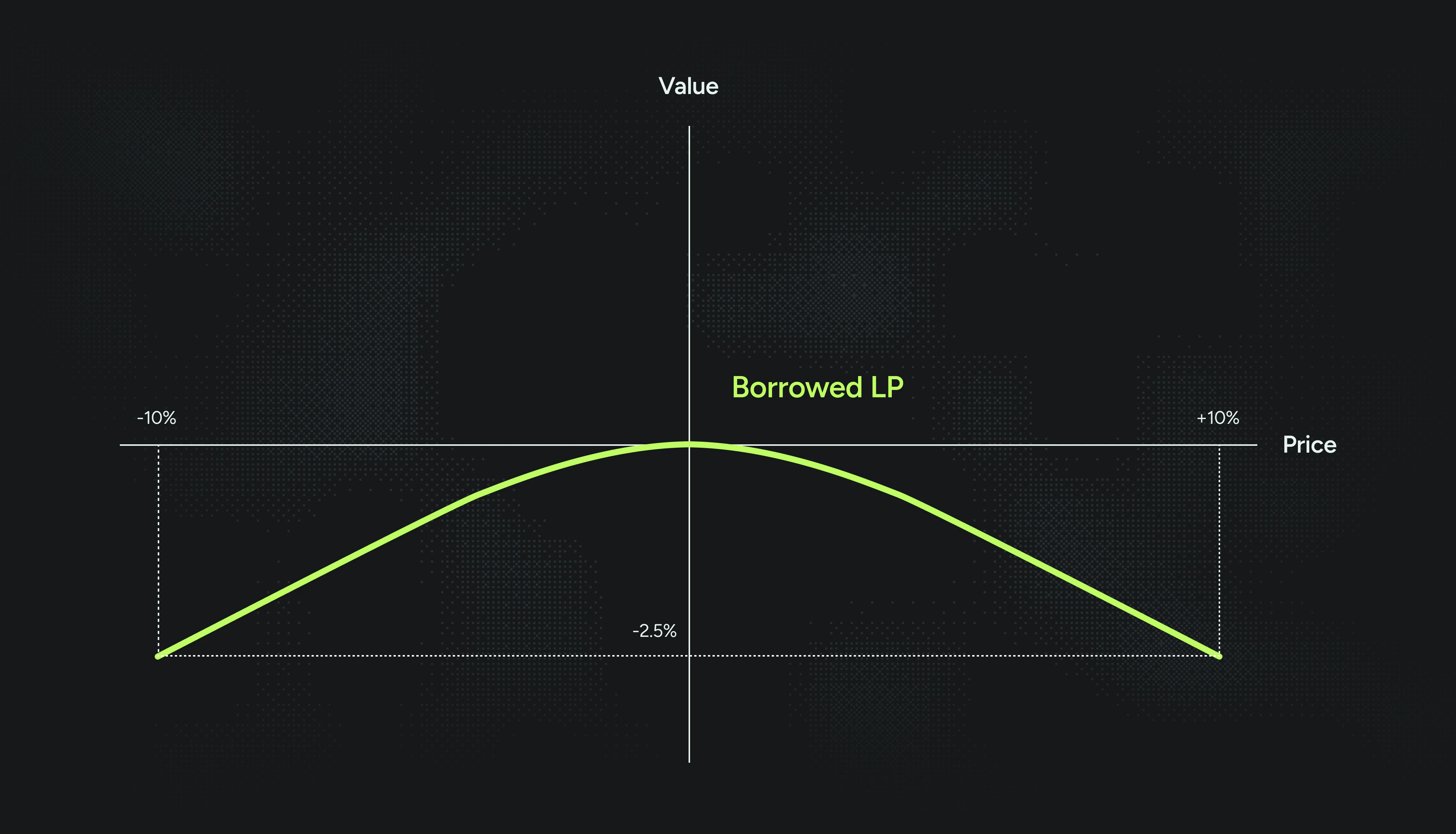
PnL Profile of Borrowed LP Position The mechanics become intuitive when you trace what happens to your LP holdings as price moves. When ETH price rises, the AMM rebalances your position—you end up holding less ETH and more USDC. Your position has effectively sold the appreciating asset on the way up, capturing less upside than simply holding. This is the behavior of someone who is short a call option. When ETH price falls, the opposite rebalancing occurs. You end up holding more ETH and less USDC. Your position has accumulated more of the depreciating asset on the way down. This is the behavior of someone who is short a put option. Combined, a delta-neutral LP is short both a call and a put. The position loses value whenever price moves away from the entry point, regardless of direction.

Quantifying the Loss

For a concentrated liquidity position with a geometrically symmetric price range [Pa,Pb][P_a, P_b] centered around the entry price P0P_0, the PnL of the borrowed position can be approximated as r/4r/4, where rr is the relative deviation from entry price to the boundary. The maximum loss occurs when the price reaches either boundary (PaP_a or PbP_b). For example, if the range is ±20% from the entry price, the maximum loss is approximately 5% of the initial investment.